


If Social Media Can Impact My Self-Worth, What Does It Do to Teens?

Updated: Aug 27
I’ve been active on social media for about 20 years. I’ve used it to share personal and professional updates, and I’ve managed social media accounts for several organizations and clients.
I understand how social media works. I know that algorithms determine who sees what we post. I know that engagement can be unpredictable and that a post getting little attention doesn’t necessarily mean it wasn’t good, interesting or important. When I post something and people react to it, I’m buoyed by it. I feel like I did something right. When someone comments or shares it, that’s even better.
Just yesterday, someone reacted to a three-year-old Facebook post from when I was celebrating my 50th birthday. I went back and noticed there were 238 comments. Just that number brought a smile to my face. People shared their recollections of how we first met. Boy did it feel good. The comments and reactions to my recent post about Emily’s first day of school make me smile, too.
That’s one of the things I love about social media. It helps us connect with people and preserve memories. It lets us share moments with friends and family who might otherwise never see them.
But there’s another side to it.
Join me and Dawn Neuburg for Ep. 55 of Shining Light on Shadows: A Candid Conversation About Mental Health, "The Mental Health Impacts of Social Media on Teens AND Adults" on Thursday, August 27 at 7 pm ET / 6 pm CT. Sree Sreenivasan is the guest. You can watch the recording on Facebook*, Twitter, LinkedIn, YouTube or my website.
*Facebook will delete the video in 30 days.
When something I post gets very little response, I can find myself wondering: What did I do wrong?
For me, ADHD and rejection sensitivity make social media particularly difficult. There can be an imperative to optimize everything—to get the wording, pictures, timing and presentation just right. When the response is lukewarm, it can be hard not to take it personally
I should know better.
Knowing something and feeling something, however, are two different things. The way my mind interprets it, if someone likes a post, that must mean they like me. If someone doesn’t like a post, or if very few people like a post, that must mean they don’t like me. (Literally. I am the post. People are either liking me or not.)
It has taken a lot of work for me to take back some of the power social media has over me.
Some days are better than others.
I’d be lying if I said I never felt jealous when I see posts from a vacation or a celebration of a professional accomplishment. I still have trouble seeing posts from people I used to work with because they can bring up a complicated mix of emotions.
I know that someone else’s success doesn’t diminish my own. I know social media gives us a carefully selected view of other people’s lives. My head knows better. My heart still feels jealous.
Which leads me to a question I keep coming back to:
If this is what social media can feel like for a fairly educated, 53-year-old, mostly well-adjusted adult who has spent years working professionally with these platforms, what is it like for a teenager growing up with them?
And that question becomes even more uncomfortable when I think about my role as a parent.
Have I modeled good social media behavior for my daughter?
I don’t think I always have.
I reach for my phone pretty frequently. I only recently became more intentional about setting it aside at mealtimes.
My wife is much better about this. She’s been told she’s a social introvert. She prefers small groups and people she knows, not large crowds or public interactions. She isn’t on Facebook and isn’t particularly active on social media. She does lurk on some platforms, but mostly for things like Trader Joe’s new products or estate sale announcements.
We waited until Emily was 13 before giving her a fully functioning cell phone. Before that, we let her watch YouTube, where she spent a lot of time watching videos about things like Minecraft, crochet and drawing. These days, YouTube Shorts has become a favorite diversion.
She isn’t allowed to use social media yet, and she isn’t allowed to message people she doesn’t know in real life.
But we know that one day, probably sooner than I’d like, she will be active on social media and subject to the same algorithms and some of the same emotional responses that I struggle with.
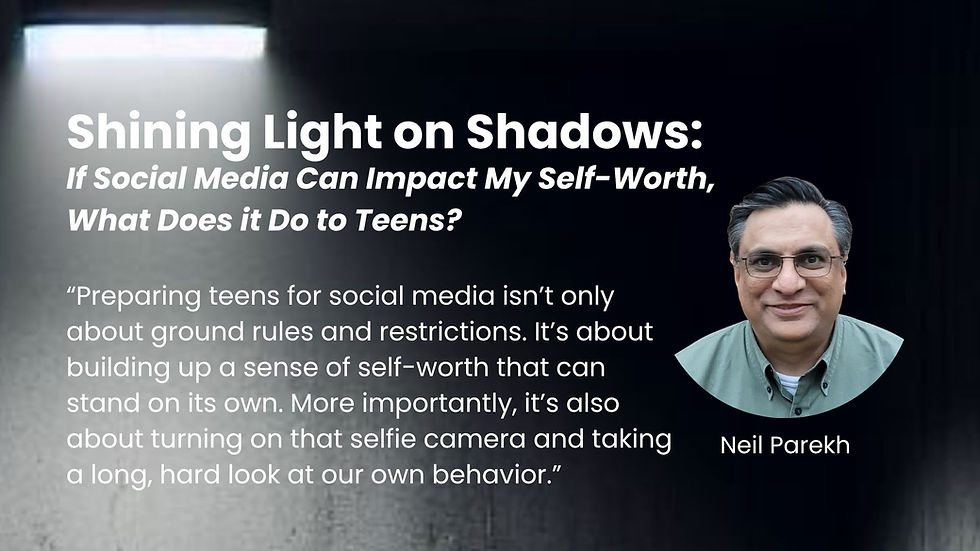
I’m realizing that preparing a teenager for that isn’t only about ground rules and restrictions. It’s about building up a sense of self-worth that can stand on its own. More importantly, it’s also about turning on that selfie camera and taking a long, hard look at my own behavior.
It’s hard to tell my child that their self-worth shouldn’t be measured by likes and positive comments if I’m still struggling with that myself. It’s hard to tell them to put their phones away and be present if they constantly see us reaching for ours.
We need to be more intentional about the power social media has over us.
That’s part of what we’ll explore on Ep. 55 of Shining Light on Shadows: A Candid Conversation About Mental Health, “The Mental Health Impacts of Social Media on Teens AND Adults.” Dawn Neuburg and I will be joined by Sree Sreenivasan to talk about what social media is doing to young people AND what it may be doing to the rest of us, too.
Maybe helping our kids develop a healthier relationship with social media starts with being honest about our own.

Related Blog Post


Comments