


When Art Opened the Door Back to Myself
Updated: Jul 10
For much of my adult life, I knew exactly who I was. A physician. A pediatric gastroenterologist. A professor. A mentor. A division chief. A mother. An immigrant woman who came to this country with her husband, worked hard, raised a family, and built a meaningful career in medicine.
Like many women of my generation, I learned early to keep going. You worked hard and took what came in stride. You did not complain. You carried every responsibility and proved your worth by rising, by mentoring, by holding the hands of those who needed guidance, and by letting others realize how indispensable you were.
Then came the time to think about stepping away from everything I had built. I was not truly ready to retire. But the environment around me had changed, and the work that had once nourished me had begun to take something from me instead. Letting go felt like letting go of a baby I had raised.
I had expected rest. I had expected freedom. What I did not expect was the void.
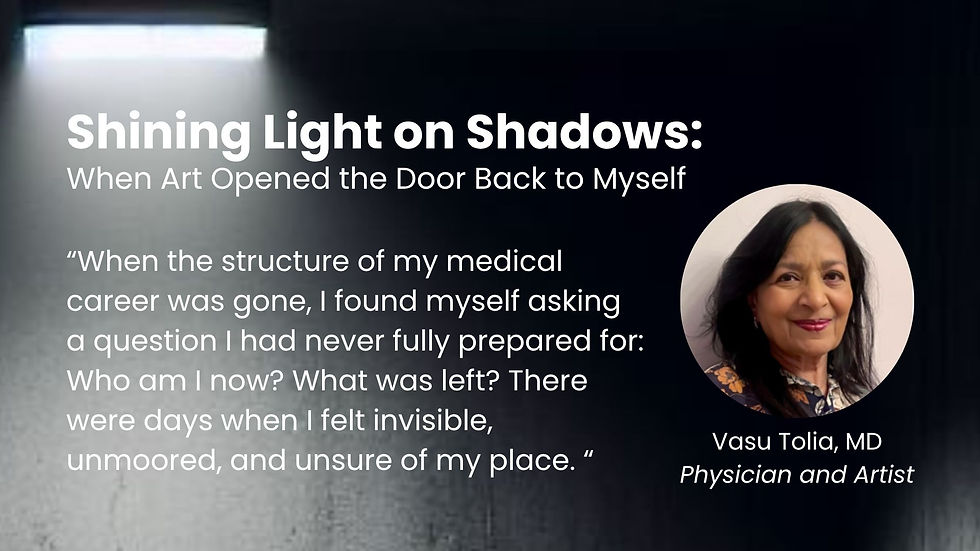
I will be discuss the challenges I had after retirement and my transition from physician to artist on Ep. 52 of Shining Light on Shadows: A Candid Conversation About Mental Health, "Art, Hope, and Ending the Shame Around Mental Health." The show will be livestreamed Thursday, July 9 at 7pm ET / 6pm CT. It is hosted by my nephew, Neil Parekh and Dawn Neuburg. I hope you can join. You can watch the live show or recording on Facebook*, Twitter**, LinkedIn, YouTube, or Neil's website. (You can find more details about the show on his website.)
*Facebook will delete the video in 30 days (approx. August 8).
When the structure of my medical career was gone, I found myself asking a question I had never fully prepared for: Who am I now? Beyond being a doctor, teacher, mentor, mother, and friend, what was left?
There were days when I felt invisible, unmoored, and unsure of my place. In hindsight, that restlessness and emptiness may have had some features of subtle depression, though I never sought formal help or had a formal diagnosis. I am deeply grateful that my family did not let me become a shell of myself. My husband came up with all sorts of ideas for me to pursue. He and my sons wanted to see the go-getter in me return. I tried music. I tried singing. Eventually, I found painting.
Art entered my life gradually. I did not set out to become an artist. I began by making marks, experimenting with color, copying what I saw, and learning one step at a time. At first, it simply gave me something to do. Then it gave me something deeper: calm, focus, and a way to express feelings I did not yet have words for.
Over time, painting became more than an activity. It became a language. I pursued it with the same seriousness and passion I had brought to medicine. I studied, practiced, failed, learned, entered exhibitions, gave talks, and kept building.

What began as a way to fill a void became a second calling. Since then, my work has been shown in solo exhibitions, received awards and recognition, and placed in healthcare, institutional, and corporate settings.
During COVID, when so much felt uncertain and frightening, I created a piece that was later recognized by The Washington Post and then requested by the CDC for the cover of its Emerging Infectious Diseases journal.
That moment brought my two worlds together: medicine and art. It helped me understand that healing had not left my life. It had simply changed form.

My art also gave me a way to serve. I support charities that matter deeply to me, including No Shame On U, Lift Up the Vulnerable, and the Ted Lindsay Foundation.
I create work connected to healing, women’s empowerment, dignity, resilience, and the natural world.
Some of my figurative pieces are, in a way, role models on canvas: women who are seen, strong, tender, complex, and becoming. This is my way of encouraging women who have felt subdued.
As a visual artist, I often speak about painting, but I believe creativity is much broader than that. For one person, it may be writing. For another, music, crochet, cooking, gardening, dancing, walking, sewing, or arranging a space with care.
There are countless forms of creative expression.
Creativity gives us a doorway into what we feel. It can help us begin conversations that are otherwise difficult to start.

That is one reason the mission of No Shame On U matters so much to me. Their work reminds us that mental health conversations should not be hidden in silence or shame.
Art and storytelling can help people find language for what they are carrying. When someone feels seen or heard, even without explaining everything perfectly, isolation begins to loosen.
Art is not a substitute for professional mental health care. When someone needs support, reaching out to a friend, a community resource, or a professional is a sign of strength, not weakness. Creativity can be one small step toward resilience. It can help us notice ourselves again.
This is also why I now speak about art, identity, healing, and becoming. I never really stopped being an educator. I simply stopped teaching medicine and started teaching possibilities. Through my artwork and speaking, I hope to help others, especially women in transition, recognize that their next chapter can still hold purpose, expression, service, and joy.
For me, art opened the door back to myself. It gave me color after the void, voice after silence, and purpose after a chapter I thought had closed.
I now believe we are never finished becoming. Sometimes healing does not arrive as a cure or a grand transformation. Sometimes it begins quietly, with one small creative act that reminds us: I am still here. I still have something to say. I can begin again.
Sign Up to receive your free guide, "5 Creative Practices to Navigate Your Next Chapter."

Your next chapter is not something you have to figure out all at once. It begins with
one creative act, one quiet moment, one step forward into the unknown.
I hope these practices give you permission to begin, to explore, and to trust the
wisdom you already carry. This Guide will: Help You Reconnect with Your Creativity
Help You Navigate Life Transitions with Clarity
Provide Practical and Accessible Exercises

Comments